The Cost Curve: Why Day 1 and Day 60 Are Different Projects
On a fresh slow leak caught within the first 72 hours, our average mitigation invoice in Hawthorns runs between $1,400 and $3,800. That figure typically covers moisture mapping, two to four air movers, one dehumidifier, antimicrobial treatment, and three to four days of monitoring. The drywall stays. The cabinets stay. The subfloor stays. We are essentially drying assemblies in place and documenting moisture content readings back to dry standard, which the S500 defines as within 4 percentage points of an unaffected reference material.
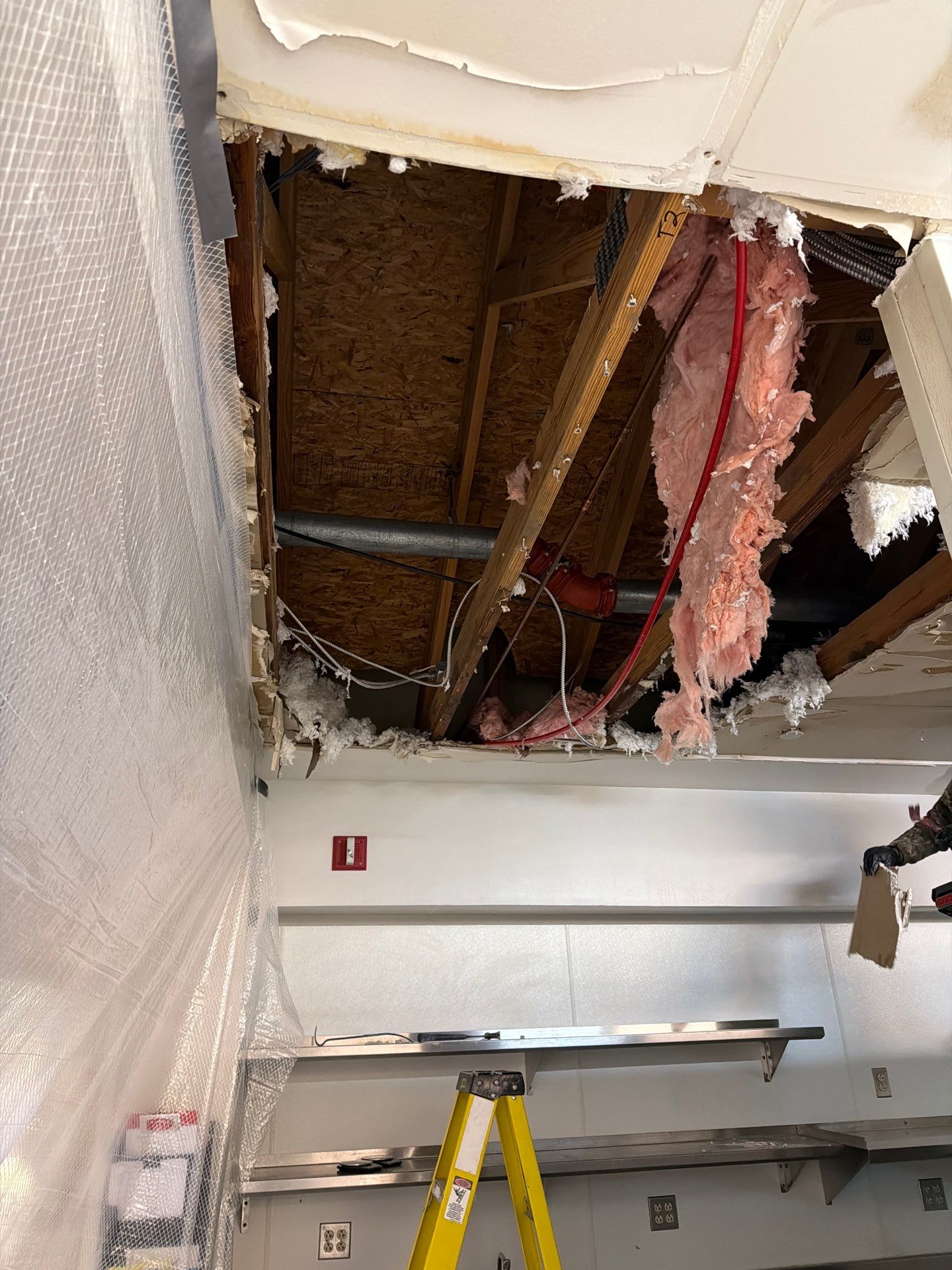
Push that same leak out to 30 days and the numbers shift. Drywall that absorbed water for a month has usually wicked moisture 12 to 24 inches above the wet line, and the paper facing has begun supporting microbial growth in roughly 60 to 70 percent of cases. Mitigation invoices in this window land between $4,500 and $9,200, because we are now removing 2 to 4 feet of drywall, extracting wet insulation, and adding HEPA air scrubbers. If you want the full breakdown of how moisture migrates through wall assemblies, our guide to water damage behind walls and hidden leak detection shows the typical migration patterns we document.
At 60 to 90 days, the project changes character entirely. Now we are looking at structural framing with elevated moisture readings (above 19 percent in wood), cabinetry delamination, hardwood cupping that exceeds 1/8 inch, and visible mold colonization in 80 to 95 percent of cases. Total restoration costs in this range typically run $12,000 to $25,000, with mold remediation alone accounting for $2,500 to $7,000 of that figure. Beyond 120 days, we have seen single family projects in Hawthorns cross the $40,000 threshold once subfloor replacement, joist sistering, and full kitchen or bath rebuilds enter the scope.
Where Slow Leaks Actually Originate
About 38 percent of the hidden leak calls we run in Hawthorns trace back to supply line fittings under sinks, dishwashers, and refrigerators, where a compression nut loosens over 5 to 15 years of thermal cycling. Another 22 percent come from toilet wax rings and flange seals, which fail gradually as the wax compresses and the toilet rocks. Roughly 18 percent originate at shower pan liners and tile grout, where the failure point is often a hairline crack invisible from above. The remaining 22 percent splits between water heater tank seepage, HVAC condensate drains, and washing machine supply hoses with rubber that exceeds the typical 5 year service life.
The diagnostic challenge is that water moves laterally along the path of least resistance, which means the visible stain on your ceiling or baseboard is rarely above the actual leak source. We have documented leaks that originated 14 feet horizontally from where the homeowner first noticed discoloration. This is why thermal imaging and pin meter readings matter: guessing wrong on the source means cutting drywall in the wrong room.
Seasonality also shifts the failure distribution. In Hawthorns, supply side fitting failures spike by roughly 25 to 30 percent during the January and February cold snaps, when copper contracts and compression joints loosen. Shower pan and grout failures concentrate in the spring and summer, when warmer indoor humidity slows evaporation from tile substrates. Water heater seepage tends to cluster in the seventh through twelfth years of tank life, with anode rod depletion driving most of those calls. Tracking which category your home fits helps prioritize inspection intervals.
The 48 hour Mold Threshold and What It Costs
The IICRC S520 standard treats 48 to 72 hours as the window in which most building materials transition from Condition 1 (normal fungal ecology) toward Condition 2 or 3. On slow leaks, that clock has typically run out long before discovery. Our field data shows visible mold growth on the back side of drywall in approximately 65 percent of slow leaks discovered after 14 days, climbing to over 90 percent past 45 days. The 48 hour mold growth rule explains the biology in more detail, but the cost implication is straightforward: any project past two weeks should include containment, negative air pressure, and post remediation verification, which adds $1,800 to $4,500 to the invoice.
Air quality testing is the other line item that scales with discovery time. Pre remediation spore counts above 1,500 per cubic meter (compared to outdoor baselines of 200 to 800 in Central Indiana) trigger a different containment protocol and roughly $600 to $1,200 in lab fees per clearance round. On projects discovered past the 60 day mark, we budget for two clearance cycles in about 35 percent of cases, because residual reservoirs in wall cavities can reseed the air after initial cleaning.
Reference Table: What the Numbers Mean for Your Decision
| Indicator | Typical Range | What It Tells You |
|---|---|---|
| Water bill increase | 15-40% above baseline | Active supply side leak, 50-200 gallons/day |
| Moisture content in drywall | Above 16% | Active wetting, drying needed |
| Wood framing moisture | Above 19% | Structural risk, mold likely |
| Drying timeline | 3-7 days typical | Longer means materials trapped moisture |
| Mitigation cost per affected room | $1,200-$4,800 | Depends on materials and saturation |
Insurance, Documentation, and the Gradual Damage Exclusion
Most homeowner policies cover sudden and accidental water damage but exclude gradual seepage that persists beyond 14 days. Carriers deny somewhere between 30 and 45 percent of slow leak claims on this basis. The defensible path is documented early discovery, which means moisture mapping reports, photographs with timestamps, and a clear repair invoice from the plumbing trade showing the failure mode. We provide that documentation on every job and coordinate directly with adjusters. Our broader water damage restoration process is built around making the claim defensible, not just the drying technically correct.
When Hawthorns Water Restoration dispatches a crew, in most cases within 2 hours of the initial call, the first 30 minutes on site are spent producing the documentation set that adjusters look for: a sketch of affected areas, moisture readings at 10 to 15 points per room, photographs of the source, and a written scope tied to S500 categories and classes. That packet alone improves claim approval rates by roughly 20 to 25 percentage points in our experience, even on leaks that are clearly past the 14 day mark, because it shows the gradual damage was not ignored once identified.