Step-by-Step Crawl Space Water Damage Protocol
Step 1: Initial Phone Triage (5 to 10 minutes)
- Confirm water source: groundwater, plumbing supply line, sewage backup, or storm intrusion.
- Assess IICRC category. Category 1 (clean supply line), Category 2 (gray water), or Category 3 (sewage, flood water).
- Estimate standing water depth in inches and approximate crawl space square footage.
- Verify access point location and clearance height (most Hawthorns crawl spaces run 18 to 36 inches).
- Dispatch decision: emergency response within 60 to 90 minutes for active water, same-day for stabilized sites.
- Ask whether HVAC ductwork runs through the crawl space. Wet flex duct and saturated trunk line insulation change the scope significantly.
- Confirm pets, sump pump status, and any recent pesticide treatments before Hawthorns Water Restoration crews arrive.
Step 2: On-Site Assessment (20 to 40 minutes)
- Technician suits up in Tyvek, respirator (P100 minimum for Category 2 or 3), and headlamp.
- Photograph entry conditions for your insurance file.
- Map water depth at 4 to 6 points using a calibrated probe.
- Take moisture readings on floor joists, subfloor underside, and sill plate using a pinless meter. Dry baseline for wood is 12 to 16 percent in Central Indiana.
- Inspect for structural concerns: cracked piers, displaced vapor barrier, compromised insulation batts, exposed wiring.
- Identify the source. We will not start extraction if active water is still flowing. See our guidance on hidden leak detection for source isolation.
- Check for visible microbial growth on joists. Surface staining older than 72 hours often indicates a pre-existing condition that requires separate documentation.
Step 3: Source Control and Scope Agreement (15 to 30 minutes)
- Shut off water main or isolate the failed fixture.
- Document scope in writing with line items: extraction, removal, drying, sanitization, replacement.
- Provide a written price range. Typical Hawthorns crawl space jobs run $2,200 to $7,500. Category 3 sewage events can reach $9,000 to $15,000.
- Obtain signed work authorization and insurance assignment if applicable.
- Confirm deductible, policy limits, and whether your carrier requires pre-approval for demolition over $2,500.
Step 4: Water Extraction (1 to 4 hours)
- Deploy truck-mounted extractor for volumes over 50 gallons. Smaller events use portable units rated at 100 to 145 CFM.
- Run suction hose to the lowest point. Pump rate averages 15 to 30 gallons per minute.
- For sewage events, follow our sewage cleanup protocol with full PPE and biohazard containment.
- Remove and bag saturated insulation. R-19 and R-30 batts hold 4 to 7 pounds of water per batt and cannot be salvaged.
- Cut and dispose of damaged vapor barrier in 6-foot sections for clean removal.
- Squeegee residual water toward the extraction point. Standing water under 0.25 inches will be addressed by absorbent passes rather than pumping.
Step 5: Demolition and Material Removal (2 to 6 hours)
- Remove all wet fiberglass insulation. 100 percent replacement is standard.
- Pull damaged vapor barrier (6-mil or 10-mil poly).
- Inspect rim joists and band boards for delamination.
- Flag any structural members showing more than 25 percent moisture content for engineered evaluation.
- Bag and remove debris in 6-mil contractor bags. Sewage debris goes in red biohazard bags.
- Remove and tag any subfloor sections showing visible swelling or seam separation greater than 1/8 inch.
Step 6: Antimicrobial Application (45 to 90 minutes)
- Apply EPA-registered antimicrobial (typically a quaternary ammonium compound) to all wood surfaces.
- Coverage rate: 1 gallon per 200 to 300 square feet.
- Allow 10 minutes of dwell time before drying equipment activates.
- For Category 3, apply a second pass after 24 hours.
- Log product name, EPA registration number, batch, and total volume applied for the chain-of-custody file.
Step 7: Structural Drying Setup (1 to 2 hours)
- Calculate dehumidifier load. Standard formula: cubic feet of space divided by 50 to 60 for Class 2 drying.
- Deploy LGR (low grain refrigerant) dehumidifiers rated at 130 to 240 pints per day. One unit covers 1,200 to 1,800 cubic feet.
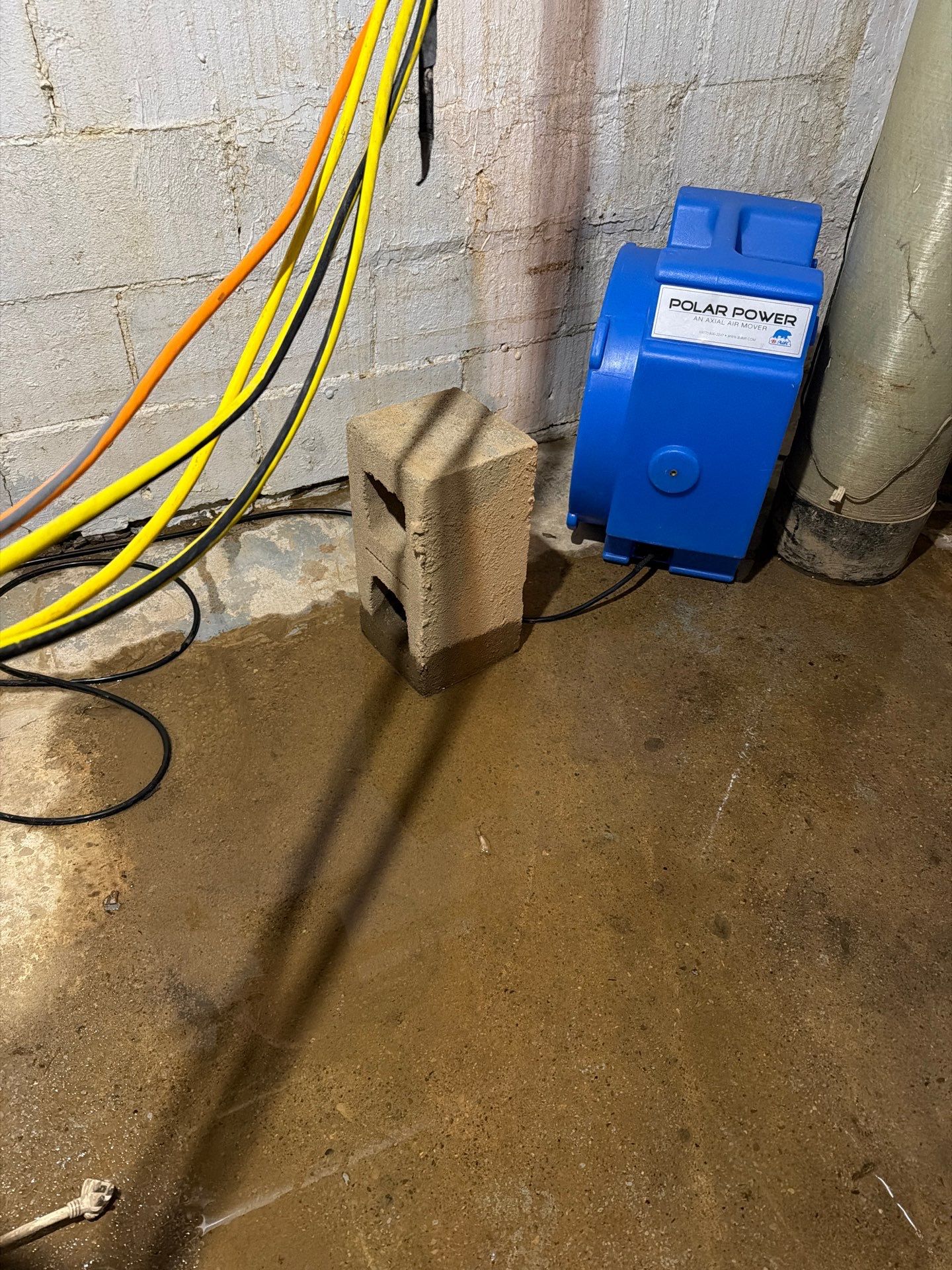
- Position air movers at 16-inch spacing along joist bays. Target: one mover per 50 to 75 linear feet.
- Seal crawl space vents with 6-mil poly and tape to create a controlled drying chamber.
- Set target conditions: 60 to 75 degrees Fahrenheit, relative humidity below 40 percent.
- Route condensate discharge hoses to an approved drain or condensate pump. Never discharge back into the crawl space.
Step 8: Daily Monitoring (3 to 7 days)
- Daily moisture readings at the same 6 to 10 marked points.
- Document temperature, RH, and GPP (grains per pound) at the start of each visit.
- Adjust equipment placement as dry zones expand.
- Most Hawthorns crawl spaces hit dry standard in 4 to 6 days. Older homes with dense framing can run 7 to 10 days.
- Verify equipment amperage draw on each visit to catch failing capacitors before they extend the dry-out.
Step 9: Verification and Equipment Removal
- Confirm wood moisture content has returned to within 2 percentage points of the unaffected baseline.
- Verify RH below 50 percent for 24 consecutive hours.
- Generate final drying log with daily readings, photos, and equipment runtime.
- Remove all extraction and drying equipment.
- Perform a final pinless sweep across 100 percent of accessible joist bays to confirm no hidden wet pockets remain.
Step 10: Reconstruction and Prevention
- Install new 10-mil or 12-mil reinforced vapor barrier with 12-inch overlap seams.
- Replace insulation. Closed-cell spray foam (R-13 to R-19) outperforms fiberglass in flood-prone Hawthorns crawl spaces.
- Recommend sump pump or French drain if groundwater was the source. Review our sump pump failure guide for sizing.
- Final walkthrough with photos for your insurance adjuster.
- 30-day workmanship check-in by phone.
Equipment Inventory for a Typical Hawthorns Water Restoration Crawl Space Job
- 1 to 2 LGR dehumidifiers (130 to 240 PPD class)
- 6 to 12 axial air movers at 2,800 to 3,400 CFM each
- 1 truck-mount or portable extractor (100 to 145 CFM)
- 1 HEPA air scrubber rated 500 to 700 CFM for Category 2 or 3 events
- Pinless and pin-type moisture meters, thermo-hygrometer, and infrared camera
- 6-mil containment poly, Tyvek suits, P100 respirators, nitrile gloves
Common Failure Points We Inspect Before Sign-Off
- Plumbing penetrations through the sill plate. Foam sealant degrades after 8 to 12 years and creates entry points for moisture.
- HVAC condensate lines terminating inside the crawl space rather than to an exterior drain.
- Downspout extensions discharging within 4 feet of the foundation wall.
- Grade slope. Hawthorns lots should fall at least 6 inches over the first 10 feet from the foundation.
- Crawl space access door seals. Gaps over 1/4 inch allow humid summer air to drive interior dew points above 65 GPP.
Pricing Reference for Hawthorns Homeowners
- Extraction only (under 2 inches standing water): $800 to $1,800
- Full Category 1 dry-out with insulation replacement: $2,200 to $5,500
- Category 2 with antimicrobial and partial demo: $4,500 to $8,000
- Category 3 sewage event: $7,500 to $15,000
- Vapor barrier replacement: $1.25 to $2.75 per square foot
- Closed-cell spray foam encapsulation upgrade: $3.50 to $6.00 per square foot